How to Check for Fake Followers on X (Twitter): A Practical Guide
You probably have fake followers. Not because you bought them, but because bot networks target active accounts automatically. Research estimates that 5 to 15 percent of all X (formerly Twitter) accounts are bots or fakes, which translates to potentially hundreds of millions of accounts globally.
The question isn't whether you have fake followers. It's how many, and whether they're distorting your metrics enough to matter.
Why Fake Followers Actually Hurt You
The obvious concern is vanity metrics, but the real damage is more specific.
They Tank Your Engagement Rate
Engagement rate is calculated by dividing interactions (likes, replies, retweets) by follower count or impressions. Fake followers never engage. They just sit there, inflating the denominator.
Here's a concrete example: an account with 10,000 followers averaging 50 likes per tweet has a 0.5% engagement rate. Remove 2,000 fake followers and keep the same 50 likes, and the engagement rate jumps to 0.63%. That's a 25% improvement in a metric that brands, algorithms, and partnership evaluators all look at.
A healthy engagement rate on X typically falls between 1% and 5%. If you're consistently below 0.5%, fake followers may be part of the reason.
They Poison Audience Data
If you use follower demographics to inform your content strategy, geographic targeting, or ad spend, fake followers skew everything. A bot farm in one region can make it look like 20% of your audience is from a country where you have zero real customers.
They Cost You Brand Deals
Brands and agencies now routinely audit influencer accounts before signing deals. A high fake follower percentage is a dealbreaker, even if you didn't purchase them. The reasoning is simple: if 30% of your followers are fake, the brand is paying for 30% less reach than advertised.
Red Flags: How to Spot Fake Followers Manually
Before using any tool, you can learn a lot by scrolling through a follower list and checking individual profiles. Here are the specific patterns to look for:
1. Default or Stock Profile Pictures
Real users almost always upload a photo. An account with the default egg/silhouette avatar combined with minimal activity is one of the strongest bot indicators. Some more sophisticated bots use AI-generated faces or stolen photos, but the default avatar plus zero tweets is a near-certain tell.
2. Random Character Usernames
Usernames like @xkf8392jd or @sarah_jones_28493 with long strings of random numbers are common among batch-created bot accounts. Legitimate users occasionally have numbers in their handles, but the pattern is different: @john2023 looks human, @john_28473910 does not.
3. Zero or Near-Zero Tweets
An account following 3,000 people but with 0 to 5 tweets of its own is almost certainly a follow-bot. Real users post content. The exception is very new lurker accounts, but those are a tiny minority.
4. Extreme Follower-to-Following Ratios
Most real users follow roughly as many people as follow them, within an order of magnitude. An account following 10,000 users but with only 50 followers is engaged in follow-churning, a tactic used by bot networks to inflate follower counts on target accounts.
Established influencers and celebrities are the exception: they typically maintain ratios of 10:1 or higher (many more followers than following). But a non-celebrity account with a 1:200 ratio (following 10,000, followed by 50) is suspicious.
5. Suspicious Growth Spikes
If you track your follower count over time (using twtData's Profile Tracker, for example), sudden jumps of hundreds or thousands of followers in a single day, not tied to any viral content or media appearance, likely indicate a bot influx.
6. No Engagement Despite High Impressions
On X specifically, the impressions metric makes this easy to spot. If a tweet gets 100,000 impressions but fewer than 100 interactions (likes, replies, retweets), the audience is overwhelmingly passive or fake. Accounts with real followers typically see 1% to 5% engagement relative to impressions.
Using twtData's Bot Detector for Automated Audits
Manual checking works for spot-checks but doesn't scale. twtData's Bot Detector uses machine learning to analyze multiple signals per account simultaneously:
- Account age and creation patterns — bots are often created in batches, so clustering of creation dates is a signal
- Tweet frequency and timing — bots often post at unnaturally regular intervals or during off-hours
- Follower-to-following ratio — the asymmetry described above
- Profile completeness — real users fill out bios, add locations, set profile images
- Username entropy — random character strings vs. natural name patterns
- Engagement quality — real accounts have varied interaction patterns; bots are repetitive
- Content originality — real users create original content; bots typically retweet or post templated text
The output is a bot probability score for each account analyzed. It's free for up to 10 accounts per check, with no signup required.
Interpreting the Results: Fake Follower Percentage Scale
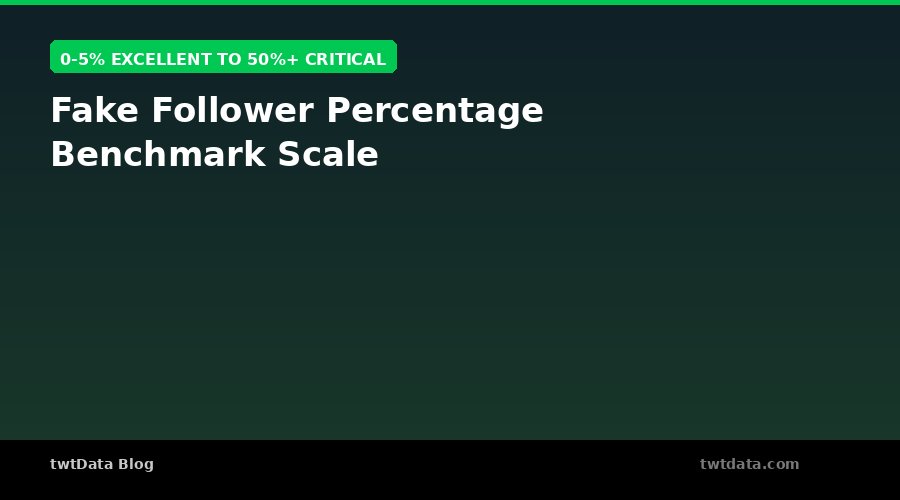
Industry benchmarks for fake follower percentages, based on aggregated audit data:
- 0 to 5%: Excellent. Minimal bot presence. Typical of smaller, organically grown accounts.
- 5 to 15%: Normal. Even well-managed accounts accumulate some bots over time. Most active Twitter accounts fall here.
- 15 to 30%: Concerning. Worth investigating. Could indicate targeted bot activity or a past follower purchase by a previous account manager.
- 30 to 50%: Poor. Significantly impacts engagement metrics and audience data reliability.
- 50%+: Critical. Strongly suggests purchased followers at some point in the account's history.
Going Deeper with Follower Analytics
For a comprehensive audit that goes beyond bot/not-bot scoring, twtData's Follower Analytics generates a full report on any account's follower base. This includes:
- Geographic distribution — unusual concentrations in regions known for bot farms (certain countries disproportionately represented) are a red flag
- Interest and profession breakdown — a tech influencer whose followers are primarily interested in gambling or cryptocurrency (when they don't post about either) suggests purchased or misdirected bot followers
- Activity level distribution — what percentage of followers are active vs. dormant
A free demo report is available so you can see the format before committing.
What to Do About Fake Followers
You have a few options once you've identified them:
Block individually. Blocking an account removes it from your follower list. This is manual and time-consuming but effective for the most egregious bots.
Wait for X's purges. X periodically removes bot accounts in bulk. When this happens, you may see a sudden follower drop. This is normal and healthy.
Focus on engagement over count. Rather than obsessing over removing every bot, focus on growing genuine engagement. A smaller, engaged audience outperforms a larger, fake-inflated one by every measure that matters.
Audit regularly. Once per quarter is a good cadence for most accounts. If you're growing quickly or running paid campaigns, monthly audits catch issues faster.
Frequently Asked Questions
What percentage of Twitter followers are typically fake?
Research estimates that 5 to 15% of all X accounts are bots or fake. Larger accounts tend to attract more bots simply due to visibility. An account with 100,000 followers having 8 to 12% fake followers would be within normal range. Above 15% warrants investigation.
Can I remove fake followers from my account?
You can block individual fake accounts, which removes them from your follower list. There's no mass-removal tool provided by X. Periodic platform-wide bot purges by X also reduce fake followers automatically. The most practical approach is to block the most obvious bots and focus on growing real engagement.
Do fake followers hurt my account's reach?
Yes, in two ways. First, they reduce your engagement rate (a metric algorithms and potential partners evaluate). Second, if X's algorithm factors engagement rate into distribution decisions, lower engagement means your tweets may be shown to fewer real followers.
Should I use a tool that asks for my Twitter password to audit followers?
No. Legitimate audit tools only need a public username. Any tool that asks for your X password is almost certainly a phishing attempt. twtData's Bot Detector requires only the username of the account you want to analyze.
How often should I audit my followers?
Quarterly audits are sufficient for most accounts. If you're an influencer negotiating brand deals, monthly audits help you maintain clean metrics. If you notice a sudden unexplained follower spike, audit immediately to determine if it's a bot influx.
Can I tell if a specific influencer bought followers?
No tool can definitively prove a purchase, but the signs are strong: a sudden spike of thousands of followers in a single day (not correlated with viral content), a high fake follower percentage (30%+), and low engagement relative to follower count all suggest purchased followers. twtData's Bot Detector and Profile Tracker together can identify these patterns.